
75% of consumers prefer to buy products in their native language. Another study reveals that 60% rarely or never purchase from English-only websites. These aren’t just statistics. They’re warnings about money left on the table.
Picture this: A customer in Tokyo tries to resolve an issue with your product. Another in São Paulo has questions about your service. A third in Dubai needs technical support. If they all have to communicate in a language they’re not comfortable with, what happens? Frustration builds, problems go unsolved, and customers leave.
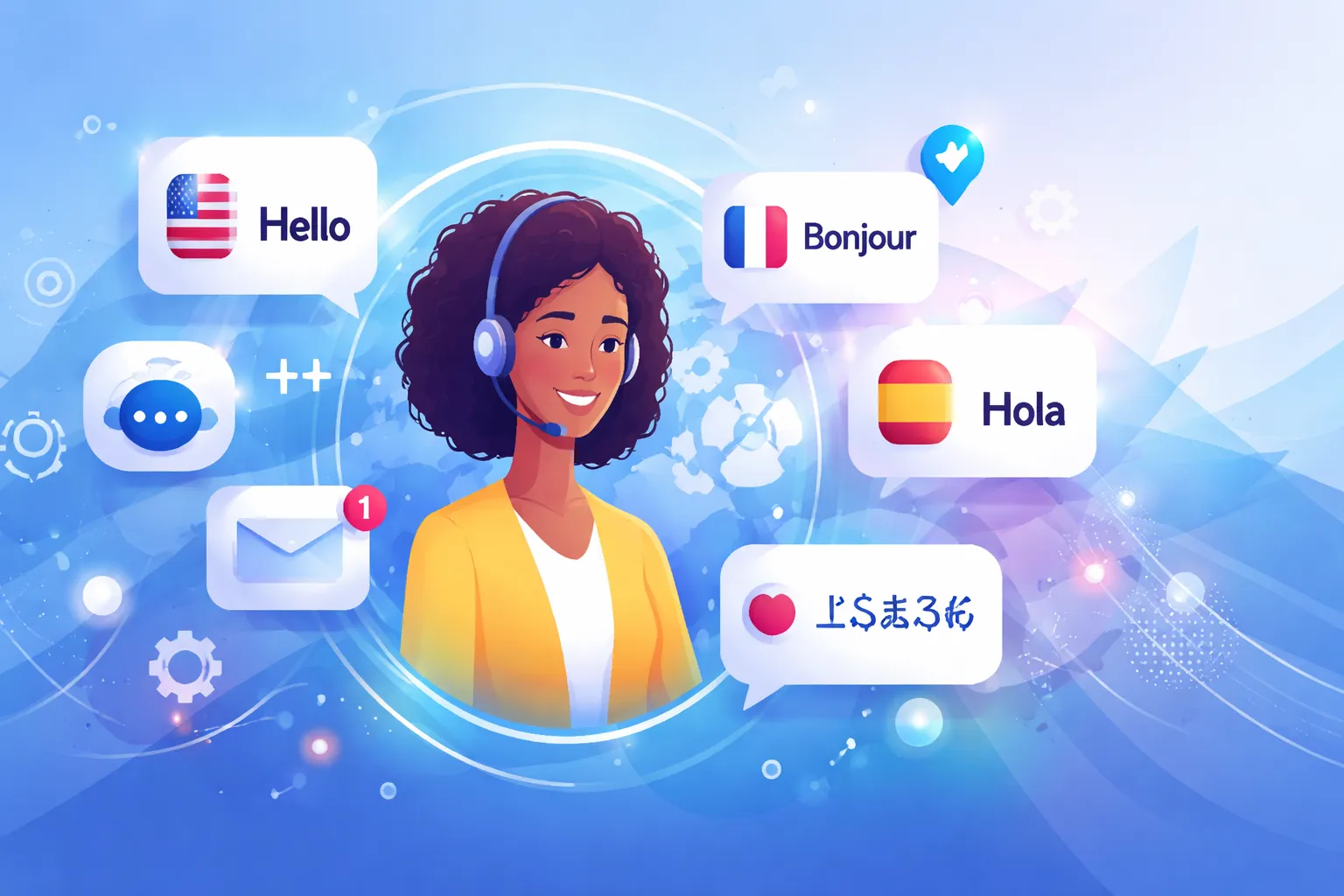
Multilingual customer support bridges this gap. It allows businesses to serve customers in their native languages across voice, chat, email, and social media channels. In today’s global marketplace, where language barriers directly impact your bottom line, the question isn’t whether you need it. It’s how quickly you can implement it.
This guide breaks down what multilingual support actually means, why it matters more than ever, and how companies like Technotask Global help businesses deliver seamless experiences across 16+ languages and multiple time zones.
Understanding Multilingual Customer Support
Multilingual customer support means providing customer service in multiple languages to accommodate diverse customer bases. This includes native or fluent speakers who understand cultural context and nuances, omnichannel support across phone calls, live chat, email, social media, and help documentation, real-time assistance without making customers wait for translations, and cultural awareness that ensures messaging resonates appropriately across different markets.
1. Native Language Fluency
True multilingual customer service requires agents who are native speakers or completely fluent in the languages they support. These agents understand idioms, cultural references, and conversational nuances that automated systems and basic translators cannot replicate. They build authentic rapport with customers who immediately recognize genuine fluency.
2. Omnichannel Language Coverage
Support must extend across every customer touchpoint. Whether customers prefer phone calls for urgent issues, live chat for quick questions, email for detailed inquiries, or social media for public engagement, each channel needs consistent language support. Help documentation, FAQs, and self-service resources should also exist in all supported languages.
3. Real-Time Communication
Customers expect immediate assistance in their preferred language. Waiting for translations or being transferred multiple times creates frustration. Effective multilingual support routes customers directly to agents who speak their language, eliminating delays and improving resolution speed.
4. Cultural Intelligence
Language and culture connect deeply. Support agents need to understand cultural norms around communication styles, problem-solving approaches, and customer expectations. What resonates in direct German business culture differs significantly from relationship-focused Arabic communication styles or the formal hierarchies common in many Asian cultures.
Also Read – Why Omni-Channel BPO Is Key for E-Commerce Growth & CX
Business Case for Multilingual Support
Language barriers cost businesses real money. When customers cannot communicate effectively, several things happen. Support tickets take longer to resolve because of miscommunication. Customer satisfaction drops when people feel misunderstood or struggle to explain problems. Sales conversions suffer as potential buyers abandon purchases due to language concerns. Brand reputation takes a hit in markets where language support is missing.
Measurable Business Impact
Companies that invest in multilingual support see higher customer retention rates in international markets, increased average order values when customers shop in their preferred language, better online reviews and Net Promoter Scores across different regions, and reduced support escalations because issues get resolved correctly the first time.
Market Opportunities
Markets like the UAE, India, and Latin America represent massive growth opportunities. Companies entering these markets with proper multilingual customer support gain immediate advantages over competitors operating only in English. The ability to communicate naturally in local languages opens doors that remain closed to businesses treating language as an afterthought.
Key Advantages of Multilingual Customer Support
The multilingual support benefits extend far beyond basic communication. They fundamentally change how your business operates in global markets.
1. Expanded Market Reach
Every language you add opens doors to new customer segments. Supporting Arabic unlocks the entire Middle Eastern market with its young, digitally engaged population and high purchasing power. Hindi and regional Indian languages give you access to 1.4 billion potential customers in one of the world’s fastest-growing economies. Spanish connects you to 21 countries and over 500 million speakers across Latin America, Spain, and large US markets.
Companies often see 20-40% increases in market penetration when they launch proper language support in new regions. The difference shows up immediately in conversion rates, cart abandonment metrics, and customer acquisition costs.
2. Improved Customer Experience
When customers interact with support agents in their native language, problems get explained more clearly and understood faster. Solutions feel more personalized and culturally appropriate. Customers feel valued and respected by your brand. Overall satisfaction scores jump by 30-50% compared to English-only support.
This improvement translates directly to customer behavior. People who receive support in their preferred language leave better reviews, recommend brands more frequently, and demonstrate higher tolerance when occasional issues arise.
3. Competitive Advantage
Most companies still operate primarily in English. Offering true multilingual customer support immediately differentiates you in markets where competitors provide limited language options. In markets where competitors provide only English support, you gain instant credibility and preference among local customers.
This advantage proves particularly powerful in emerging markets where local competitors may lack resources for professional support operations while international competitors haven’t yet invested in local language capabilities.
4. Increased Revenue and Customer Lifetime Value
The financial impact is direct and measurable. Studies show customers spend up to 2.5 times more with companies that provide support in their language. They also stick around longer, with retention rates improving by 15-25% when language barriers are removed.
The revenue impact comes from multiple sources, including higher initial conversion rates, larger average order values, more frequent repeat purchases, lower churn rates, and increased customer lifetime value across all supported language segments.
5. Better Brand Reputation
Word spreads fast in local markets. When your company provides excellent support in local languages, customers tell others. Online reviews improve with more positive sentiment and higher ratings. Social media conversations become more favorable. Your brand becomes known as one that genuinely cares about all customers.
This reputation creates compounding advantages. Local media covers companies providing exceptional localized experiences. Industry awards and recognition follow. Recruiting top local talent becomes easier when your brand has positive recognition in the market.
Also Read – Customer Experience in 2026: Key Trends Shaping the Future of Engagement
Industries Where Multilingual Support Is Critical
While every global business benefits from multilingual customer service, certain industries find it absolutely essential.
1. E-commerce and Retail
Online shopping platforms serve customers worldwide. Supporting multiple languages for product descriptions, checkout processes, and customer service directly impacts conversion rates. Companies like Noon in the UAE have built their success partly on comprehensive multilingual support that makes Middle Eastern customers feel understood and valued.
Product questions, sizing inquiries, delivery tracking, returns processing, and payment issues all require clear communication. When customers can explain concerns in their native language, resolution happens faster with fewer misunderstandings.
2. Financial Services
Banking, insurance, and investment services require clear communication about complex topics. Customers need to understand terms, conditions, and financial advice in their native language. Regulatory compliance also often requires communication in local languages to ensure customers truly comprehend what they’re agreeing to.
Financial services customers dealing with mortgages, investments, insurance claims, or fraud concerns cannot afford miscommunication. The stakes are too high, and trust depends on clarity.
3. Healthcare and Pharmaceuticals
Patient care cannot afford miscommunication. Medical information, appointment scheduling, prescription guidance, and insurance coordination must be crystal clear. Healthcare providers in diverse markets need multilingual support to ensure patient safety and satisfaction.
A patient who cannot clearly explain symptoms or understand treatment instructions faces serious health risks. Healthcare organizations serving diverse populations must provide support in all languages their patient communities speak.
4. Travel and Hospitality
Hotels, airlines, and travel platforms serve international customers by nature. Booking assistance, itinerary changes, and emergency support must be available in multiple languages, often 24/7 across all time zones.
Travelers need support in their native language when dealing with flight cancellations, hotel issues, lost luggage, or emergency situations in unfamiliar locations. Hospitality businesses without adequate language coverage lose bookings to competitors offering better accessibility.
5. Technology and SaaS
Software companies serving global markets need technical support in local languages. Complex troubleshooting and product explanations become much more effective when delivered in the customer’s native language.
Enterprise SaaS platforms serving international clients particularly need comprehensive language coverage. When technical issues arise, customers need to explain complex problems clearly and understand detailed solutions. Language barriers turn simple fixes into prolonged frustrations.
6. Food Delivery and Quick Commerce
Platforms like Swiggy, Dunzo, and international players need real-time support in local languages for customers, delivery partners, and restaurant partners. Issues need immediate resolution, making language fluency critical for operations.
Address corrections, order modifications, delivery delays, and payment problems require instant communication. Delivery platforms operating across linguistically diverse regions need agents who can switch seamlessly between languages as situations demand.
Real-World Examples of Multilingual Customer Support
Looking at actual multilingual customer service examples shows how this works in practice.
1. Noon UAE
The Middle Eastern e-commerce platform Technotask supports serves customers primarily in English and Arabic. Support agents handle everything from order inquiries to delivery issues, refunds, and product questions. The system processes queries through chat and voice channels, with average response times under 30 seconds and resolution times around 7 minutes. The result is an 80% customer satisfaction score and smooth operations across multiple Middle Eastern markets.
2. Swiggy India
Swiggy operates across India, where language diversity is massive. Technotask provides support in Hindi, English, Kannada, and Telugu for Swiggy’s delivery partner network. This includes onboarding new delivery partners, handling operational issues, and managing reactivation of dormant partners. The multilingual approach ensures partners in different regions can communicate comfortably, leading to better retention and performance.
3. Dunzo Hyperlocal Delivery
Dunzo’s platform serves customers, delivery executives, and merchant partners across multiple Indian cities. Technotask manages three separate support streams in Hindi, English, Kannada, Telugu, and Tamil. Each stream handles pre-delivery issues, post-delivery problems, and real-time coordination. This multilingual structure enables quick resolution of location issues, order modifications, and delivery concerns across diverse linguistic markets.
4. Global BPO Operations
Technotask operates centers in India, UAE, Egypt, UK, USA, and KSA, providing support in 16+ languages including English, Arabic, Hindi, German, French, Lithuanian, Romanian, and all major Indian regional languages. This infrastructure allows clients to serve customers across time zones and language groups with consistent quality and cultural understanding.
How to Implement Multilingual Customer Support: Best Practices
Delivering effective multilingual customer support requires more than just hiring people who speak different languages. These practices separate good from great multilingual operations.
1. Hire Native Speakers or Highly Fluent Agents
Translation tools cannot replace human understanding of idioms, cultural references, and conversational nuances. Native speakers catch subtle communication issues that automated systems miss. They also build better rapport with customers who immediately recognize authentic fluency.
Hiring criteria should prioritize true language mastery, cultural background from the target market, customer service aptitude and empathy, and ability to explain complex concepts clearly in the target language.
2. Provide Cultural Training
Support agents need to understand cultural norms around communication styles, problem-solving approaches, and customer expectations. Training should cover communication preferences in different cultures, appropriate formality levels and greeting customs, cultural attitudes toward complaints and conflict, and religious and social considerations that affect service delivery.
3. Use the Right Technology Stack
Multilingual support requires tools that handle multiple languages seamlessly. This includes CRM systems with language tags and multilingual field support, chat platforms that route to appropriate language queues automatically, knowledge bases in multiple languages with proper localization, quality monitoring tools that work across language groups, and speech analytics that can process and analyze conversations in all supported languages.
4. Maintain Consistent Quality Across Languages
Every language channel should deliver the same high-quality experience. This means standardized training programs covering all shifts and languages, regular calibration sessions across language teams to ensure consistency, quality metrics that apply equally to all languages, and cross-language benchmarking to identify and address performance gaps.
5. Create Language-Specific Resources
Help documentation, FAQs, scripts, and training materials should exist in all supported languages. Content should be localized to reflect how native speakers actually communicate, addressing common questions specific to each market and using culturally appropriate examples and scenarios.
6. Optimize Routing and Staffing
Match agents to customers based on language preference automatically through intelligent routing systems. Consider language needs alongside other factors like issue complexity and agent expertise. Staff appropriately for different time zones and regional peak hours to ensure adequate coverage when customers in each market are most active.
7. Monitor and Measure Performance
Track metrics separately by language to identify gaps. First response time, resolution time, customer satisfaction, and first contact resolution should be measured for each language channel. This reveals where specific language teams need additional support or training and ensures no language group receives inferior service.
8. Build Continuous Improvement Loops
Regular feedback sessions, coaching based on actual customer interactions, and knowledge base updates based on common questions ensure multilingual support keeps improving. What works today may need adjustment as markets evolve and customer expectations change.
In-House vs Outsourced Support: A Strategic Comparison
Companies face a strategic decision when building multilingual customer support capabilities. Both approaches have merits depending on business needs, scale, and growth plans.
|
Aspect |
In-House Multilingual Support |
Outsourced Multilingual Support |
|
Control |
Maximum control over operations and quality |
Shared control with established frameworks |
|
Product Knowledge |
Deep, integrated product expertise |
Requires knowledge transfer but quickly ramped |
|
Talent Access |
Difficult to hire native speakers for multiple languages in one location |
Access to established multilingual talent pools across 16+ languages |
|
Scalability |
Expensive and complex to scale up/down |
Easy to ramp up or down based on business needs |
|
Cost Structure |
Full-time salaries and benefits for all languages |
Pay for services delivered, typically 30-50% less |
|
Infrastructure |
Must build 24/7 coverage and technology from scratch |
Ready-made infrastructure across time zones |
|
Time to Deploy |
3-6 months to hire, train, and establish operations |
4-8 weeks with experienced partner |
|
Best For |
Very specialized products, 1-2 primary markets, support drives product development |
Multiple languages needed, rapid market expansion, cost efficiency required |
Hybrid Models
Many companies find success with hybrid approaches. They keep core, high-volume languages in-house while outsourcing less common languages or overflow capacity. Some handle complex, product-specific issues internally while partners manage routine inquiries across multiple languages. Others maintain in-house teams for primary markets with outsourced support extending to secondary markets and emerging opportunities.
These flexible approaches balance control with the practical realities of serving diverse global markets effectively.
How Technotask Global Supports Your Multilingual Needs
Technotask Global provides comprehensive multilingual customer support capabilities specifically designed for modern, growing businesses. With 5,500+ employees across 20+ delivery centers in 6 countries, the infrastructure supports seamless multilingual operations at scale with 16+ languages including English, Arabic, Hindi, German, French, Lithuanian, Romanian, and all major Indian regional languages. Deep UAE market experience supporting major platforms like Noon for e-commerce and Western Union for financial services translates to understanding local customer expectations and effective resolution approaches across diverse markets.
The combination of omnichannel support delivery across voice, chat, email, and social media, AI-enhanced solutions like XENY AI voicebot and Convoze speech analytics, and specialized industry expertise in e-commerce, food delivery, financial services, and technology makes expansion into new markets fast and reliable. Certified quality management through ISO 9001:2015, ISO 27001:2013, and PCI DSS compliance ensures consistent excellence across all language channels, while proven scalability allows rapid hiring and training of 750+ employees in just 15 days when business demands require quick capacity increases or new market launches.
Conclusion
Multilingual customer support transforms from nice-to-have to business-critical as companies expand globally. The benefits are clear: expanded market reach, improved customer experience, competitive advantage, increased revenue, and stronger brand reputation across diverse markets.
The question is how to implement it effectively. From hiring native speakers and building cultural understanding to deploying the right technology and maintaining consistent quality, the operational complexity requires expertise and infrastructure that most businesses cannot build quickly or efficiently on their own.
Technotask Global removes these barriers. With proven capabilities across 16+ languages, 20+ delivery centers, and specialized industry expertise, we help businesses deliver exceptional customer experiences regardless of language or location.
Whether you operate in e-commerce, financial services, travel, technology, or any industry serving international customers, evaluating your current language capabilities against market opportunities reveals growth potential that directly impacts business success.
Ready to expand your customer support capabilities? Contact Technotask Global to discuss how multilingual support can accelerate your growth in new markets and strengthen customer relationships globally.
Frequently Asked Questions(FAQ's)
What
languages should my business prioritize for
multilingual support?
Start with languages spoken by your largest customer segments or target markets. Common priorities include Spanish for Latin America, Arabic for Middle East, and Hindi for India. Analyze website traffic and purchase data to decide which languages offer the best ROI.
How much
does multilingual customer support cost?
Costs vary by languages needed, support channels, and hours of operation. Outsourcing typically costs 30-50% less than building in-house capabilities. ROI shows up quickly through increased conversions and retention in new markets, often within 6-12 months.
Can AI
replace human agents for multilingual support?
AI handles routine queries effectively in multiple languages, but human agents remain essential for complex issues requiring cultural nuance and empathy. The best approach combines AI for efficiency with native-speaking humans for quality situations requiring judgment and relationship-building.
How quickly
can multilingual support be implemented?
With an experienced outsourcing partner, basic multilingual support launches in 4-8 weeks including agent recruitment, training, technology setup, and process development. In-house builds typically require 3-6 months for comparable capability across multiple languages.
What metrics
should we track for multilingual support
performance?
Track standard support metrics by language including first response time, resolution time, customer satisfaction scores, first contact resolution, and ticket volume. Also monitor language-specific indicators like agent proficiency scores and market-specific NPS to ensure consistent quality across all languages.